
Everyone wants to achieve perfect eyebrows to complete their look. The eyebrow is an attention-getting signature element of your face. Analyzing the unique nature and expressiveness of your brows with AI can be a useful tool on many levels. In the beauty industry, software to identify and modify facial features (facial morphing) is commonly used. Virtual plastic surgery involves computer programs and generated images to show you how your face could look if modified. This service was once exclusively available in the cosmetic surgeon’s office. Then apps like FaceTouchUp and BodyPlastika were developed to allow you to preview a cosmetic procedure from your phone, without scheduling an office visit. Tools like Benefit’s Brow Try On and Maybelline’s Brow Play Studio reside on corporate websites; providing customers a service that allows them to try on different eyebrows. App versions like Sephora’s Virtual Artist were a natural extension the cosmetic giants’ web-based services.
Soon a new app may be out that focuses specifically on eyebrows. U.S. Patent Application No. 2020/0126314 describes a technique for facial landmark detection to identify brows from a selfie. Here’s an image from the patent application:
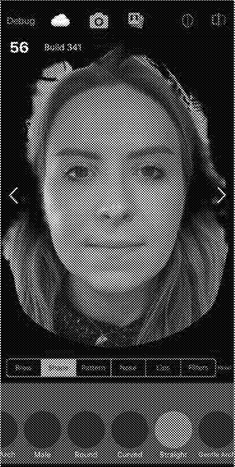
The computer program removes the identified eyebrows from the image and allows you to choose a new color and shape to apply. Then you can see how these changes would look on your face. The facial morphing analysis technique may also potentially be used to preview alterations of other facial features prior to facelift, rhinoplasty, lip augmentation, eyebrow tinting/tattooing etc. The application just published on April 23; but has already been allowed, meaning a patent could issue shortly.
The ability to identify facial landmarks like the eyebrows with AI is also useful for fields other than beauty. Since signers use not only their hands, but also their bodies and faces to communicate, AI that can accurately interpret facial expressions helps computer programmers to convert American Sign Language into text and vice versa. To translate the Bible into sign language, Avodah, Inc. of TX has created computer programs that analyze not only what movements the hands of a signer are making, but also body movements and facial expressions, as described in U.S. Patent No. 10,489,639 and U.S. Patent Publication No. 2020/0104582 (just published in April). Identification of eyebrows and capturing of their movement is an element of Avodah’s innovative method for recognizing sign language communications.
Eyebrows as a biometric identifier? A more precise system for identifying eyebrows could also aid facial recognition of people in facemasks. Hanvon (Hanwang Technology Ltd) of China is a pioneer in this arena, having created software that allows identification of a person wearing a mask from an employee database. If the eyebrow can be more precisely mapped, it would have the potential to be an identifying feature of a mask wearer. Better triangulation and ability to identify the eyebrow facial landmark could augment electronic surveillance and security. The caveat to using eyebrows for identification; however, is that they can modified in terms of shape and color.
These examples on the leading edge of technological innovation demonstrate that whether for the beauty industry or beyond, study and analysis of the eyebrows with AI is an information source worth mining.
 Beauty and the Law